

How to Review New Documents Without Losing the Record
Connect new documents to affected facts and work products, preserve earlier wording and record the review decision. Includes an Excel change register.
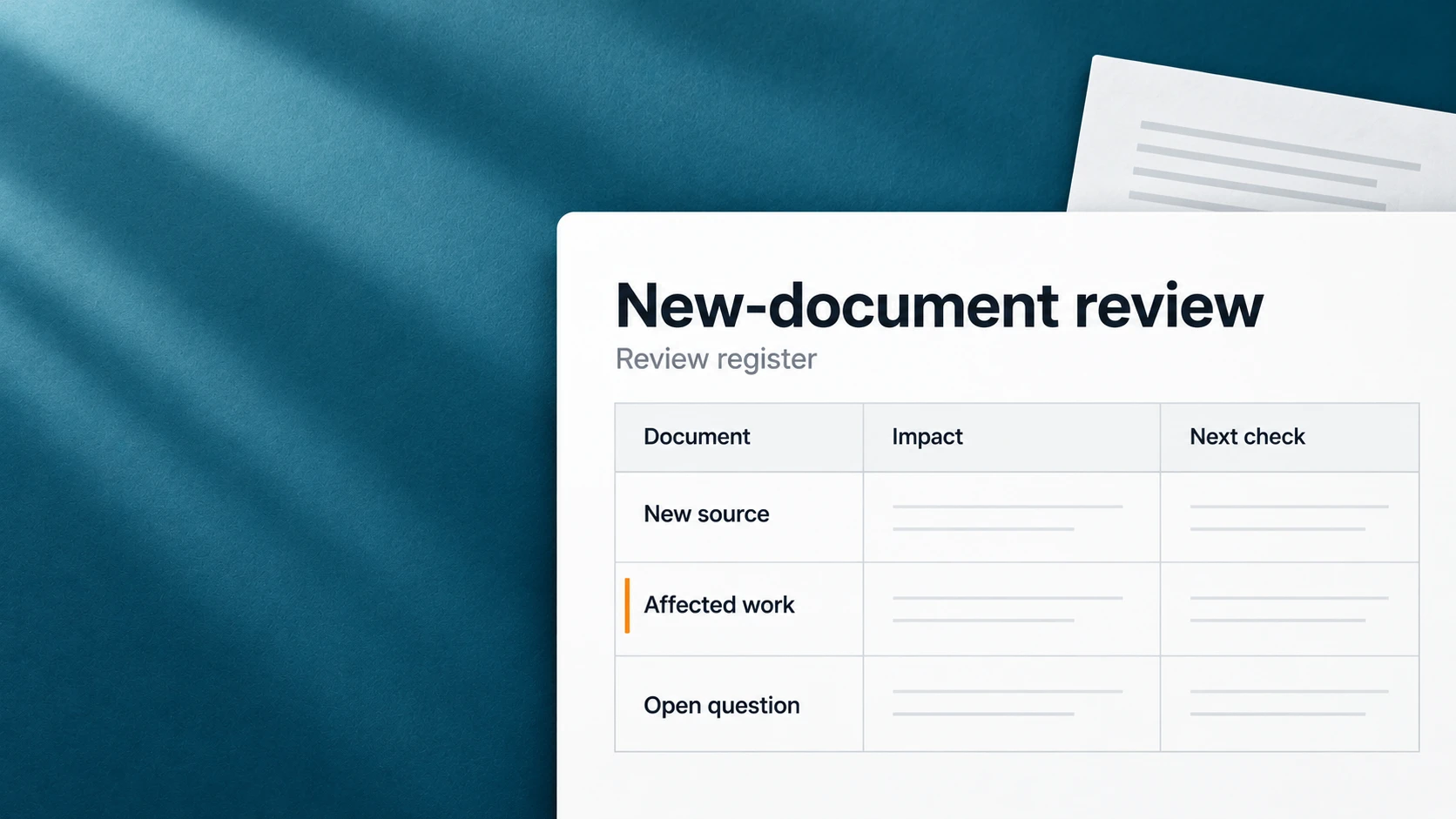
When a new document arrives, the task is to decide what it changes in the matter record. Preserve the earlier position, identify affected propositions and work products, then record a deliberate review decision. A new file should not silently rewrite the chronology or brief.
Finish with a change record that preserves the earlier wording, names each affected output and records the review decision and remaining work. The working kit includes an Excel register, a completed example, downstream checks, a prompt and fictional sources.
The register in this guide works with a folder, document system or matter workspace. It records proposed changes and human decisions. It does not promise that a tool can identify every affected fact or perform legal assessment automatically.
Record what arrived and what it contains
Give the new material a stable source ID. Record when the document was created, when you received it and when it entered the reviewed source set. These may be different dates. Preserve the original file and identify its version, attachment relationships and any processing problems.
Check whether it is new evidence, a duplicate, a corrected version or an incomplete extract. A re-sent email is not necessarily a second independent account. A corrected spreadsheet may affect previous calculations even if its filename is unchanged.
Connect the source to the existing record
Search by people, dates, issue names and stable proposition IDs. Review the evidence matrix, chronology, summaries and briefs that may rely on the affected point. Record the exact work product and version, not “all documents”.
For each impact, retain the old wording and proposed new wording. State the new source and pinpoint, why it matters and what remains uncertain. The reviewer should be able to understand the proposal without reconstructing an undocumented before-and-after comparison.
Decide whether the change is material
Ask whether the material changes a fact candidate, an attributed account, a source limitation, an open question or a piece of legal analysis. A typo correction may need a simple edit. A contrary receipt date may require reconsidering several downstream pieces of work.
Set a review priority based on the consequence for the matter and the next use of the work. Do not rank evidence as reliable solely because it was received later. New material can add another account without resolving the underlying conflict.
Record a decision of accepted, accepted with limits, rejected with reason, duplicate or unresolved. Give unresolved items an owner and next check. A review marker means the item was considered; it should not be used as a substitute for recording what the reviewer decided.
Preserve the history of the decision
Keep the earlier proposition and version identifiable. Where wording changes, record who approved the change, when it was applied and which work products were checked. If a brief is awaiting review, say so rather than marking the whole matter current.
When AI suggests an impact, inspect the cited new material and the affected earlier statement. AI risk guidance recognises the need to evaluate outputs and their limitations; an impact suggestion is a starting point for review. 1
Review the synthetic carrier record
The fictional source packet has two versions. v1 excludes DOC-007. v2 adds it. The collection register states what changed and which requested records remain absent. The equipment record is a connected running example across this library. Reusing it lets you follow the same sources through different review tasks. Apply the source and review checks to the records in your own matter.
The earlier proposition P-02 is unresolved: the supplied material does not establish when all 12 pilot units reached the warehouse. The new export records a delivery scan at the depot gate at 23:15 on 30 April (DOC-007 L02–L03). Its recipient signature is blank, and L04 does not confirm a warehouse receipt.
A sensible accepted change adds the carrier scan as a separate chronology event and includes it in the competing accounts for P-02. It does not replace the 1 May warehouse receipt with a 30 April warehouse delivery event. The proposed brief revision says that the carrier scan and warehouse records need to be reconciled.
The example register preserves the earlier wording, adds the source, records “accepted with limits” and assigns the signed consignment note check. It identifies the evidence matrix, chronology and draft brief as separate downstream checks. Completion of one edit does not automatically complete the other two.
Use Grella's review surfaces within their limits
Grella's documented Changes workflow connects source changes to affected matter understanding and work for review. That supports a reviewer finding what needs attention. It is not a guarantee that every downstream sentence has been rewritten or every conflict resolved. Check the current workspace and review the proposed impact before deciding what to change.
The downloadable register can supplement that process with explicit owners, decisions and completion checks. If the product surface available to you differs, keep using the source-linked review process. The walkthrough resource requires a separate verified recording of the shipped flow before publication.
Identify possible impacts of a new source
Check downstream work before closing the item
After the decision, open each named work product. Apply the accepted correction or record why it is unnecessary. Confirm that citations still point to the right source and that an earlier conclusion has not survived in the introduction, table or attachment.
Record completion for each work product, the reviewer and the date. Keep the change open while required work is pending. This gives a matter handover a clear account of what is current and what still needs attention.
The working kit
The Excel register includes a blank reusable log, a synthetic carrier-record example, downstream checks and field instructions. It also includes the impact prompt and the source packet. Filters help you find unresolved changes and checks assigned to a particular owner.
Keep the next review bounded
Use the register whenever new material could affect a relied-on proposition or work product. If you want to evaluate the process before wider use, follow the one-matter AI pilot guide. Contact Grella to see how changes connect to the matter record.