

How to Prepare a Source Linked Matter Brief
Prepare a focused matter brief with checked facts, competing accounts, exact source references and questions for legal judgment. Includes a Word template.
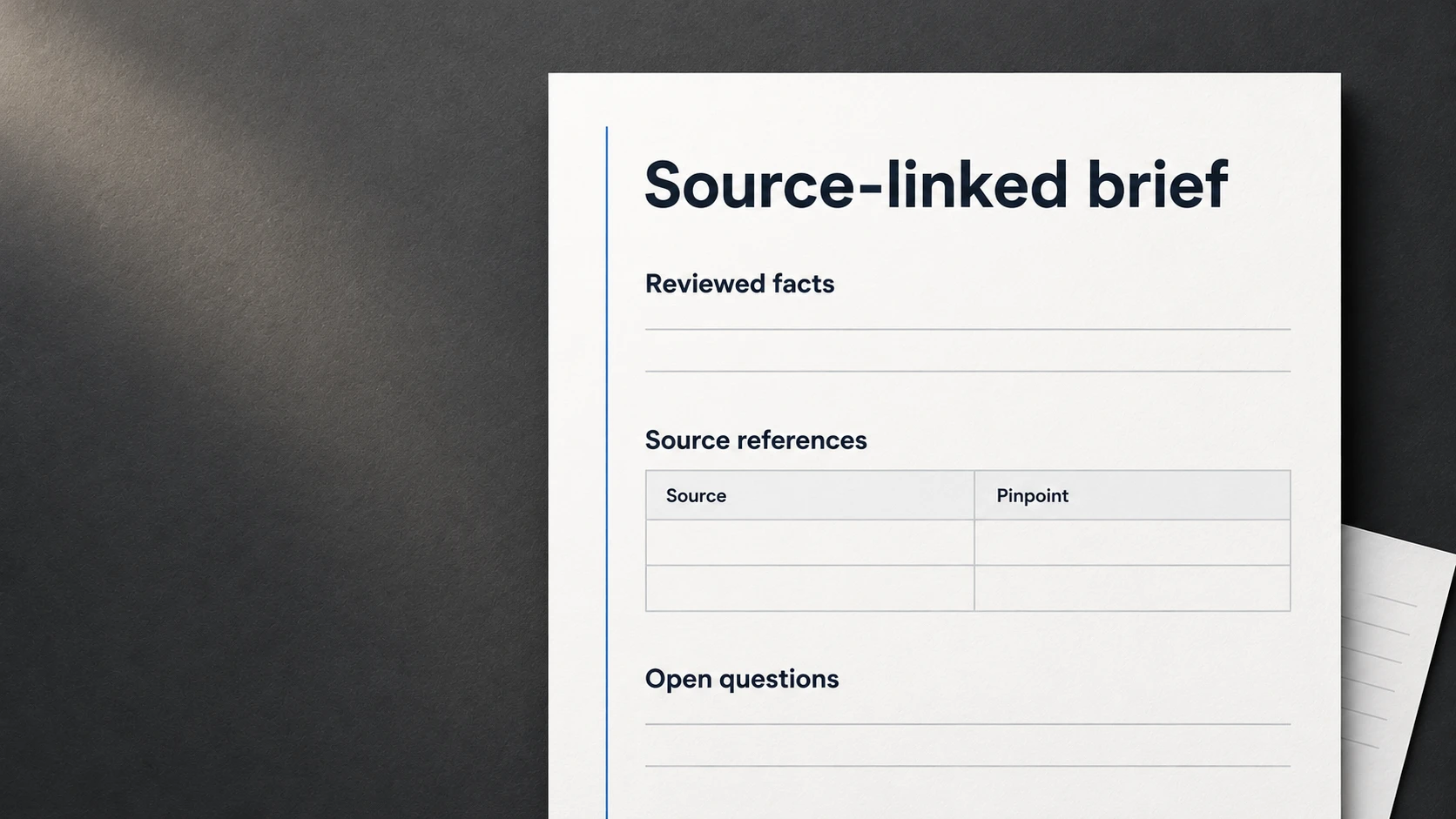
A useful matter brief gives a reader the factual record needed for a specific decision and a clear route back to its sources. Start with the purpose, then organise checked facts, competing accounts and open questions around that purpose.
Finish with an internal brief that answers a named factual question, links its material statements to sources and makes open questions visible. The working kit includes an editable Word template, a completed brief, a drafting prompt and fictional sources.
This is a template for an internal factual brief. It is not a court submission, a prescribed form or a legal opinion. The responsible lawyer supplies and reviews any legal assessment, procedural requirements or strategy.
Name the reader and decision
Write who the brief is for, what they need to decide and the question it addresses. Set an as-of date, source-packet version and scope. A brief on delivery timing should not imply that damages, inspection obligations or every contractual term have been assessed.
State the main factual position in a short opening paragraph. If the position is unresolved, lead with that. A sentence that accurately exposes uncertainty is more useful than a definitive answer assembled from conflicting records.
Build the brief from reviewed propositions
Use the evidence matrix to identify propositions checked against the supplied material. Select those that matter to this reader. Keep a compact chronology for events whose sequence affects the question.
Each material factual sentence should identify its supporting document and exact passage. Explain what the source establishes to the stated extent. A list of citations at the end cannot repair a sentence that overstates the evidence.
Preserve attribution. “The warehouse note reports” and “the warehouse received” are different propositions. Identify which one the supplied record supports. Where a fact depends on an inference, state the inference and the facts it draws on.
Put competing accounts where the reader can see them
Give the contrary account alongside the preferred account, with sources for each. Describe the conflict precisely: date, quantity, speaker, location or event type. Do not compress several distinct discrepancies into “the evidence is mixed”.
Explain what could resolve the question. Is an original missing? Is the agreement incomplete? Does a witness need to explain a term in their note? Assign the next check if it is within the brief's scope. The reader should know whether the uncertainty is a collection gap, an unresolved factual conflict or a question for legal judgment.
Use the synthetic delivery brief
The fictional completed example asks whether the supplied records establish complete warehouse delivery of the Northline pilot by 30 April. It states that the question remains unresolved. The equipment record is a connected running example across this library. Reusing it lets you follow the same sources through different review tasks. Apply the source and review checks to the records in your own matter.
The agreement extract records delivery of 12 equipment units to the warehouse by that date (DOC-001 L02, L04). Dispatch says 12 units were sent on 29 April with an estimated arrival the next day (DOC-002 L03). That is dispatch evidence, not confirmation of receipt.
The operations email reports no arrival by 16:10 on 30 April (DOC-004 L03). The warehouse receipt records 10 cartons at 08:40 on 1 May, without an inspected unit count (DOC-003 L02–L05). The 3 May unpacking note says 10 pilot units and two borrowed units were on the floor (DOC-005 L02–L05).
Sales' account and the carrier export are also relevant. Sales says its understanding is that all 12 pilot units were received on 30 April (DOC-006 L03). The carrier records a depot scan at 23:15 that day but no recipient signature (DOC-007 L02–L04). The brief keeps those accounts distinct from physical warehouse receipt.
It asks the lawyer to assess legal consequences after the full agreement, variations and missing signed consignment note are checked. It supplies no breach finding or damages estimate. Its strength is the route from the question to the source and the remaining check.
Draft with a clear boundary
If you use AI, provide the reader, question, reviewed propositions and source scope. Ask for a factual draft with unresolved questions and separate matters for legal assessment. Review the actual output before using it. Generative AI does not remove responsibility for the work product. 1
Draft a factual brief from checked propositions
Review the brief as a whole
Run the summary verification checklist. Open the source for each material assertion and check that the introduction, chronology and conclusion describe the same qualified position. Check copied tables and attachments as well as body text.
Confirm that links and document IDs work for the recipient. Record who reviewed the brief, when and which source version they used. If it will be sent outside the team, apply the firm's separate confidentiality, authority and approval checks.
Keep it current when new material arrives
Link the brief to the relevant propositions in the change register. A new receipt, variation or witness account may require a revised factual position. Preserve the earlier version and explain the change, then repeat the affected source checks.
Use the full matter handover when responsibility changes. The brief answers a defined question; the handover also covers ownership, matter continuity and the wider next-action list.
The working kit
Download the Word brief template, a completed synthetic brief, the drafting prompt and the fictional source packet. The template reserves space for scope, exact sources, review status, unresolved questions and lawyer assessment without filling them with invented conclusions.
Connect the brief to the matter record
Keep the cited facts, open questions and reviewer decisions accessible alongside the source documents. Contact Grella to see how source-linked work products fit a matter workspace.