

Organise a Source Record for Witness Preparation
Prepare neutral source maps and open questions for lawyer review while keeping witness recollection separate from documents shown later.
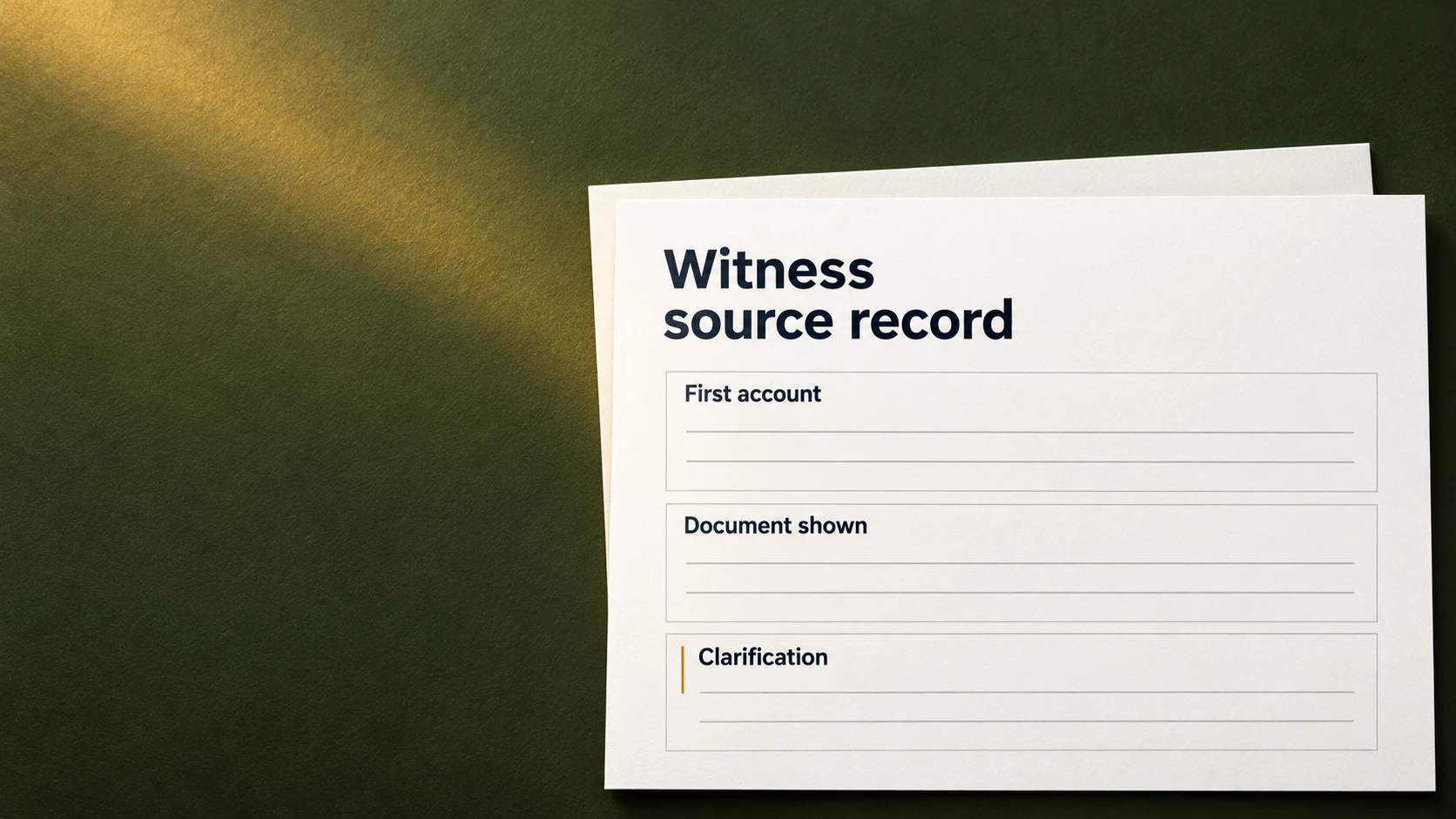
A witness preparation record should help the lawyer identify what the witness knows, which documents bear on the account and which questions remain open. Keep the witness's own recollection separate from information learned from documents or other people.
Finish with a preparation record that separates the witness's first account from the documents shown, source questions and remaining checks. The working kit includes an editable Word worksheet, a worked example, a document-organisation prompt and fictional sources.
This guide covers a source-linked preparation worksheet for lawyer review. It is not a witness statement, an affidavit, a script for testimony or a method for supplying a desired answer. Applicable professional duties, court orders and evidentiary requirements control the actual preparation.
Define the purpose and preserve the first account
Record the witness's role, the events under review, the lawyer responsible and the intended use of the preparation. Keep the original account and its actual date. Note whether an account was written unaided, given in an interview or produced after documents were shown. Do not backfill that history from assumption.
Begin with open questions about what the witness recalls. Record uncertainty and the basis of knowledge. Separate something seen or done from something heard from another person. If the witness cannot remember, retain that answer. A polished narrative can remove uncertainty that matters to an accurate record.
Build a source map before the interview
For each relevant event, list the witness's connection, source IDs and pinpoints, competing material and neutral questions to ask. Identify documents authored by the witness, documents received and records whose author or meaning is unknown. Check the full passage and attachments rather than relying on an extracted sentence.
Use the chronology to navigate events and the evidence matrix to identify unresolved propositions. These are lawyer work records. They must not quietly become the witness's recollection.
Worked example: a receipt initial and a later unpacking note
All names and records in this exercise are fictional. Lee Morgan wrote the operations email reporting no warehouse arrival as of 16:10 on 30 April (DOC-004 L01–L03). Lee also wrote the unpacking note on 3 May (DOC-005 L01–L05). The warehouse receipt of 1 May contains initials “LM” without a full name (DOC-003 L03). The equipment record is a connected running example across this library. Reusing it lets you follow the same sources through different review tasks. Apply the source and review checks to the records in your own matter.
Do not assume Lee signed the receipt because the initials match. A neutral question is: “What involvement, if any, did you have in receiving this shipment?” If the receipt is later shown, record exactly which version was shown and what Lee says about the initials and the count of cartons.
The unpacking note distinguishes 10 pilot units from two borrowed units. Ask: “What do you recall about where the units on the floor came from?” Do not ask the witness to adopt “all 12 pilot units arrived by 30 April”. The carrier's depot scan on that date is a separate source with an unidentified recipient, not a memory the interviewer should supply.
Record documents shown and changes to the account
Keep the initial response, document shown, response after viewing, correction and reason in separate fields. A witness may explain a record, correct an earlier statement or remain uncertain. Record that sequence without choosing the account that best fits the desired proposition.
For a conflict, identify the exact difference. Is it quantity, date, place, participant or terminology? The distinction between cartons and units matters in this exercise. Ask what the witness understood those words to mean and what supports that understanding. Do not resolve a conflict by prompting the witness to select the preferred version.
Check the applicable rules before using AI
The Federal Court of Australia's GPN-AI, dated 16 April 2026, addresses the integrity of witness evidence and specified disclosure requirements for AI use in preparing evidence. Paragraphs 4.8 and 4.10–4.11 are important primary references. Check the applicable court's current rules and directions before deciding whether or how AI may assist. 1
For this workflow, any prompt is limited to organising supplied documents and identifying neutral factual questions for the lawyer. It does not generate the witness's memory, voice, statement or answers. Do not feed privileged, restricted or private material into an unapproved tool. The lawyer determines the permitted process and any required disclosure.
Organise documents for lawyer preparation
The lawyer checks each proposed question against the purpose and applicable duties. Remove suggestions that assume a fact, invite adoption of someone else's account or cross into legal strategy without the necessary assessment.
Close with an accurate preparation record
Record what remains unverified, which further documents are needed and who will obtain them. Keep the interview date, attendees, materials shown and review limits. Link any correction back to the affected chronology or brief, preserving its prior version.
The source-linked brief guide helps turn reviewed facts into an internal briefing. The verification checklist helps inspect source support before reliance.
The working kit
The neutral witness preparation worksheet includes a reusable interview control record, event and source map, document-shown history and a completed synthetic example. The prompt and inspectable packet support document organisation for the lawyer. No model-generated testimony or fabricated witness approval is included. Contact Grella to discuss the matter record and review process.